Wednesday, 17 June 2009

Technology In Jobless Recovery

The technology-update dynamics (see previous post) is central to the argument that the current crisis will finish with a jobless recovery, similar to the years after the 2001 dot.com bubble burst.

The raw form of the hypothesis suggests that the firms that had shed labour during the recession subsequently invest into technology, new technology in particular, rather than expand their labour force, when demand for their products is renewed. Here are some interesting graphs (source: Fed):
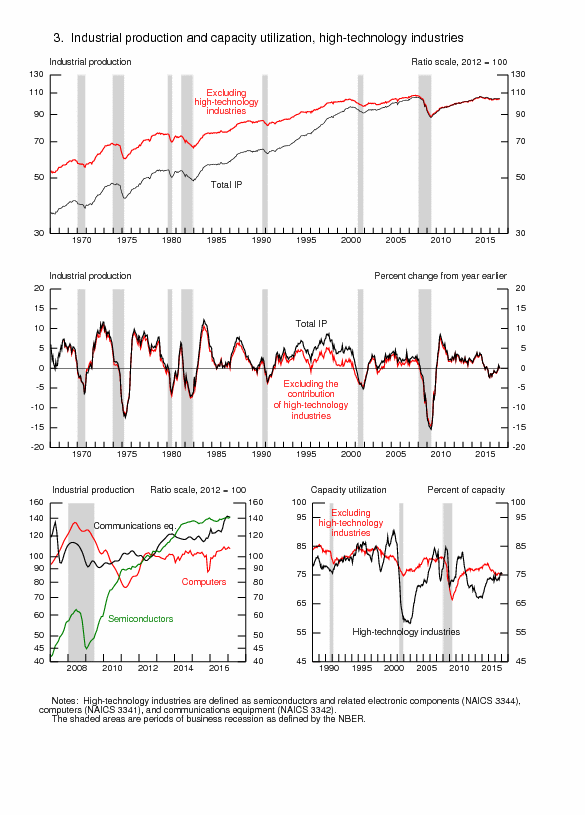
Or, in a different version (using the same data as that behind the second graph above):

(The above graph: US manufacturing growth rate MoM, minus the same without the high-tech sectors. The red line is the 12 month moving average. The second half of the 1990's is clearly over the average of the rest of the period, and the return to normal is rapid after the 2001 drop. Although this is no proof, it seems at least consistent with the hypothesis.)

Both of the above graphs suggest that there was a substantial amount of over-investment into technology before the 2001 crisis, and thus the 2002-04 years saw a productivity rise as a result in part of using the previously acquired technology, and only in part because of purchasing new technologies.

Interestingly, this is not necessarily the case for the current crisis: the level of investments into technology seems to have been on par with the rest: there was no over-investment into technology that would jump out of the data, at least not the data I am looking at now. However, the hypothesis does not necessarily require a previous over-investment, only the potential to increase production without new labour. Thus a lengthy halt to the technology-intensive fixed capital could do the same. If this was to happen so, there would be a fairly straightforward equity price consequence...

I have been trying to find data for comparable variables for the rest of the world. (The usual trouble: lack of comprehensive global statistics). The best I could come up with is the share of computer and communication services in services imports by the WBDI. Each regression had a linear time variable, and a dummy for the 1996-2004 years. Here is the result:

Eastern Europe, Latin America, Middle East, South Asia: either not significant, or low R-squared. East Asia, and the Euro area behaved - at least by this measure - in line with the US and the hypothesis. And so did Sub-Saharan Africa (but why, if the rest of the emerging and developing world did not?)

In sum, these back-of-envelope results do not contradict the hypothesis that jobless recovery stems from an underlying technology dynamics. In the case of the 2001 dot.com bubble, it seems that the productivity rise came, at least partially, from the over-investment into technology during the preceding years. This seems to be true for the mature economies, not only the US, but less so for the emerging world.

It also seems to be the case, that the mid-2000's did not accumulate excess technology intensive capital. Thus the current crisis would be different.

At the same time, the length of this recession means that investment is halted for a long time. Perhaps that means a strong demand for the new technologies after the crisis, as well as another jobless recovery.

Monday, 15 June 2009

The Jobless Recovery Scenario

The jobless recovery scenario goes like this. (1) During a recovery (as at all other times) the basic labour market identity holds: the number of people employed depends on overall demand and productivity. (2) Productivity growth depends on innovation. (3) While the relationship between employment and demand is short term, the relationship between productivity and innovation is long term. Therefore, when there is a short-term drop in economic activity, you can expect to see a fall in employment, but innovation goes on. (4) Thus when demand rebounds, there are a lot of new technologies around, and it pays to be the first to invest into them.

There was an important ‘if’ at the core of the worse case scenario: the recession will not end if the global confidence level goes where it should - to the bottom of a deep mine. Unlike with real gravity, economics is an odd place, where one might actually lift oneself up by pulling one's own hair, Baron Münchhausen-style. We saw a similar global bubble before the crisis, where most of the justification for one’s enthusiasm kept being others' enthusiasm. Bubbles can work for a surprisingly long time.

For if people want to believe that the non-existent global policy framework works, if people want to believe that the recent return to growth by asset prices has anything to do with fundamentals, and if people are willing to believe that everybody else is willing to believe, then such a global pyramid scheme might even work. In a Startlingly Pink World, there might not even be a reason for this new would-be bubble to burst; reality might grow up to it.

If that happens, an old phenomenon might return: a jobless recovery. Except, this time, potentially on a global level.

When the troubles started, there was an inevitable comparison to the last Bad Times: the 2001 burst of the dot.com bubble. Though fun, a consensus quickly emerged that there was no similarity whatsoever… Maybe, on the way out, there will be.

The most conspicuous feature of the last time the mature economies returned to growth was the delay in job creation. When the economy was already booming, employment kept lagging.

Here is the original version:


In the above graph: the red line is US industrial production, and the blue line is unemployment (both are re-based to 1997 M7 = 100%). While production returned to previous levels, unemployment stayed at a high and surprisingly stable level for years.

There has a been a lot of discussion about it; here is my version:


The above graph takes the change of the monthly rate of US unemployment data, and regresses it on the change in the monthly rate of US industrial production, and time. All are moving averages of 20 months (that’s where the R-squared peaked). A one-month lag is employed. The time series is the longest I found: 1961 to 2009, and the relationship is very close: 82% R-squared. The graph shows the fit residuals. The interesting part comes when there is a lengthy period away from the mean: the end of the 1960’s and early 1970’s see a long period of ‘too many’ jobs being in the economy, while most of the 1980’s is ‘jobless’, and then comes the ‘jobless recovery’ after the 2001 dot.com bubble.

The whole point is that there is an underlying story about productivity. If you think that in the long run, productivity dynamics rule, then the recovery is catch-up time for firms. During recession, investment into new technologies halts, and thus when there is a return to growth, the surviving companies have the option to buy into the latest technology. As the innovation cycle is much longer than most troughs (if you want evidence, look at the OECD patent stats here), this means that for a while you can increase production by investing into new technologies, and thus delay re-hiring people.

The first time this hit me was during the 2001 crisis, when I was heading an investment banking research unit and a physicist friend of mine told me about the latest developments in the physics of computer technology. We realised that if half of what he saw was really getting into production, the economy coming out of recession would be all about this and not about giving jobs back.

Investment into technology has almost entirely stopped all around the world in the past 18 months. Yet, it is very clear that the advancement of technology has been as fast as ever. And thus, we are wondering if there will be a repeat show.

(Although, I am not at all convinced that this really is the end of the recession, see the previous post. But, if it is…) You could well argue that many of the forces that created the jobless recovery seven years ago, are here now, too. In particular, the productivity mechanism might be very similar.

So, are there any signs of this?

Well, look at an interesting confidence measure from the US:


The above graph is the differential between the demand confidence and employment tendencies, survey based, from the US. (That is above zero means that the demand confidence is above the employment confidence level. The red dots are the 2002-04 years, as well as the last month's data.) Not only it confirms the jobless nature of the post 2001 recovery, but it also provides us with one point, which is very much in the same direction.

Furthermore, if you look at the other countries from which comparable data is reported, support for this argument emerges. Here is the picture of the industrial confidence and employment sentiment data from 19 OECD countries (the red line stands for the annual averages, similar confidence differential as above, positive signalling that industrial production confidence is stronger than the propensity to employ people):


And here is the same, dissected: the red countries are the four that saw the most negative differentials during the post-dot.com burst recovery, and the blue is the rest. (The lines are averages for the respective groups):


Just like the US case, it is clear that at least for the countries that saw a jobless recovery last time around, there are signs that this time might not be that different.

All this depends on the optimistic assumption that the crisis is nearing its end. Which is either still (a) in the confidence measures only; or (b) directly related to fiscal spending. (Sorry, no time to illustrate the second one in this post). This makes this scenario just as likely or unlikely as the worst-case one.

If you wanted to pick, probably it will be the size and length of the boost in self belief that will decide. If there is a moral here, then it must be about there being no point in having small Münchhausen lies.

Thursday, 11 June 2009

Now What? The W-Shaped scenario

Is this really the end of the recession?

Perhaps, there is reason to be sceptical about last month’s fashion of optimism.

The new, global economics framework for modelling the world economy in a post transition-phase state is still missing. The models we use still have major systemic errors in them, we obviously still have the same valuation problems and mis-specification of the policy mix. Despite some calling for the New Thinking, there is little new that has been put forward in reality.

Much of the problem in valuations is still here. Others argue that while the visible part of the sub-prime mess is mostly cleaned up, a lot of the less visible, but rather sizeable side-effects of it are still on the books, without ‘proper’ valuation. I would add my own observation, that the way the markets approached emerging markets has not really changed much, differentiation is still not really the name of the game. If the capital markets asked for the a realistic risk premium, some emerging market treasuries would have gone into default, whatever the urgent ambulance package was. In any case, we would see a much wider performance range from emerging markets than was the case the past months.

Plus, the policy response has been mostly inadequate. The global economy has gone through a transition phase the past ten years, making national level policy responses unlikely to do the job. The problem is that to tackle the kind of global crisis that is at hand, one would need to have enforceable monetary and fiscal policy in place, on a global level, and that is clearly not there. What has been there instead, after an initial bout of panic, is a set of protectionist measures, and a happen-to-be-at-more-or-less-the-same-time fiscal stimuli around the world that kind of works as harmonised global stimulus.

Yet, the current stimuli take most governments way-way beyond known territories: deficits are up to levels unimaginable before, and debt as well as debt projections are through the roof. For the majority of the governments the current stimulus it is a one-off action. This one really needs to work.

Which takes us to the really bad news: most of the ‘green shoots’ seem to be directly dependent on the fiscal stimuli. There is hardly anything else. Scratch any bit of ‘end of recession’ data around, independent whether the US, China, Germany, or Australia. Although there is some actual money in the pockets, it is not that much. The biggest across the board factor is the change of confidence. In other words, the governments are inducing a new bubble, and we lay all our hopes on it.

This might work. Yet, there is a significant momentum towards further slowing in the global economy. The multiplying effect of the initial hit is just taking shape. The main survival strategy in sectors hit only indirectly by the crisis has been to cut back spending as much as possible, and try to bridge over the shortage of revenues from reserves and bank loans. Banks are still hesitant to lend (even if they are ordered to by their respective governments, as we have seen many examples around the world), which means that the bridging exercise is mostly from own reserves. And there signs that reserves are running out.

If the global confidence boom will not be sustained, and there is plenty of reason why it should not be, then the coming fall might turn out to be even bigger than the one allegedly bottoming. The W-shape scenario might see a deeper, and longer, second trough.

Sunday, 7 June 2009

China Hugs The IMF

(Some good news about China's strategic choices in the global arena)

China's role on the global scene has gone through a spectacular metamorphosis in the past ten years. In the early 1990's China was still very much in the developing economy category. Although it was very large, its international behaviour resembled that of poor countries. Then, around a decade ago, its global action-set started to look more like a powerful emerging market. These were the BRIC years (an term that never reflected any real group of any cohesion, apart from encapsulating a somewhat similarish policy problem). By the mid 2000's China grew out of this category; running short on raw materials it needed to step up the power of its actions. China's search for reliable, long - and short - term sources of ores, hydrocarbon, and food led to a strategic change in the way the country approached its international relations, in particular vis-à-vis developing countries. Hence the new-found Chinese interest in African, South American, South East Asian countries.

As the current crisis intensified, China saw a strategic opportunity to forge closer, long term relationships with a host of weakened emerging markets that found themselves in desperate need of short-term funds. By doing so, China emerged as an alternative to the path offered by the international organisations, the IMF in particular. This reinforced a pre-existing battle between Chinese companies and international aid and development agencies. (I happened to see one of these local battles from close proximity, and can report that (a) it is a very real competition, and (b) all that is said about difference in post-material values is true. The international community's regard for environmental and cultural diversity, and procedural transparency - even if I sometimes feel that its by far not enough -, seems almost entirely lacking on the side of resource extraction focused Chinese approach.)

And thus the news that China committed a large sum (even if only 2.5% of its total reserves) to purchase IMF bonds is so good. Perhaps it has something to do with the country finding itself being less isolated from the global crisis, and thus weaker than it expected. Certainly, the strategic aspirations to take a global role reflecting its perceived self image are also at play here. It almost does not matter. The fact China wants to take stronger role in the global governing institutions as opposed to building its own is the best possible news.

Now the only task is to find out what these global governing institutions will do.

Thursday, 14 May 2009

Self-Delusion, Here We Go Again

Many economist spent the years before the current crisis in utter frustration. They saw their bit of the world being upside down, valuations being all over the place, and their arguments being not heard by the markets. "Hey! You gloomy guy! Shut up! If you were right, the markets would have reacted! Have you heard of efficient markets?" And thus the markets pointed at themselves as the justification for their own valuation. "This asset's value is here because we think so. Don't come to us with this shadows -in-the-cave story. That's so last millennium." (OK, millennia.)

This is why it is such an entertainment to watch the global financial markets talk themselves into exactly the same trap. "The end of the fall is here because the prices go up. The evidence is that the prices go up." And we see the analysts modelling the fundamentals scratching the wall in frustration, again, as they try to point out how meaningless the markets' very recent moves are.

Here is an example from the FT:

Traders pointed to China, which yesterday revealed a large increase in raw materials imports, reflecting in part the economic recovery but also Beijing's attempt to take advantage of lower prices to stockpile commodities. Iron ore and copper imports reached a record high last month, while crude oil imports hit their second best month at the same time.

Other analysts said supply and demand fundamentals were still weak, even taking into account China's swelling imports, and said that speculative money was the main reason behind the rally.

"Recent price strength is not based on fundamentals, but on financial flows," said Mike Wittner, oil analyst at Société Générale in London. He said investors' appetite for riskier assets such as commodities was "better entrenched, and more sustainable" than earlier this year.

That't it. "Recent price strength is not based on fundamentals, but on financial flows." Oh, how well I know this song!

Monday, 11 May 2009

U’s And V’s

(Fooling around with the credibility of global forecasts. Or the lack of it therein.)

The collapse of ability to forecast during this current global economic crisis, resulted in the abandonment of the previously employed semi-sophisticated merge of national level macro models, and the return of the U’s and the V’s. The debate is reduced to discussions whether the recession will take a u-shape or a v-shape. Not being able to do anything with the data, one can always ignore it, and assume that whatever is happening is merely a blip in the trend. All you have to do then is to figure out how fast your subject, the global economy, will return to its well established long term behaviour.

And thus the two new ‘theories’ of this crisis were born: u-shaped versus v-shaped. In both cases, the previously ‘detected’ trend will return, the only question is how long we will have to wait for it. ‘Phase transition’ is not exactly in the vocabulary of economics…

On the history of U’s and V’s.

Incidentally, I witnessed a previous occasion for these two letters to rule the explanations-and-forecasts-find-it-here business. The history of economic thought during the post-communist transition will surely spend many words on how the lack of any adequate model of what transition was, of how an economy behaves during those times, and what comes after, had resulted in the rise of discussing curve shapes. Even in some textbooks taught today, well after the rise of the New Theory of Transition, intellectual laziness keeps winning, and the discussion of the u-shaped dynamics persists.

Yet, in reality, the reduction to observing the shape of the curve, an arbitrary pattern projected onto a time series, very much in line with the statistically irrelevant, but much watched ‘technical analysis’ of capital market price data, was merely the result of no models working at all. In the early years of post-communist transition, there were three sets of theories that were offered as ‘the truth’. A bunch of economic-liberal economists, mostly of Anglo-Saxon origin, pushed ahead with the microeconomic theory of privatisation. They should have given up after a quick check, for it is obvious that the privatisation of an entire economy has nothing to do with the lessons learned from the nationalisation-privatisation saga of the British Rail. Nor, did the Theory of Poor People (a.k.a. development economics), for although the poverty stats showed a fairly bad picture, the reality had more to do with very high human capital levels all across the transition world, which rendered much of the prescriptions entirely irrelevant. Nor did the balance-obsessed monetarist approach, for - at the beginning at least - there were no institutions around that could deliver the ‘adequate policy mix’, while the underlying structure was going through a rapid and radical change.

Thrilling it is, how similar the the global economy theory-pretence is to the transition theory-pretence. The intellectual abyss is paired with a yes-of-course-I-know-EXACTLY-what’s-happening shamelessness.

On the consequences on ‘What the hell is happening to me?!?”

The previous post discussed how the IMF’s Word Of Final Truth, as usually taken without the warning about the side effects, has nothing to do with reality. Even if they happen to be right in retrospect, that will be a random event (and an unlikely one, in my view). However, there is one more phenomenon, which is mostly disregarded: the Other Views about where the current troubles come from.

One of the favourite economist bashing topics of our days is how unforeseen the current crisis was. And then a few puts their hands up and say, well, actually, they themselves had foreseen these events, and then follow on with digging up some old forecast of theirs as an evidence. That exercise is semi-interesting at best, though. For forecasting is a multi-dimensional effort in a random world, and thus if a high enough number of people are involved, there will always be some in the tail, to point at their amazing-foresight once the low probability event they forecast takes place.

A lightning will hit this bush! A lightning will hit this bush!! A lightning will hit this bush!!! Watch out!!!! Bang. Thump. Fire. OMG, OMG, I am a prophet! ... Okay, people, here is what you need to do from now on.

(Btw., my mother thinks she has healing power in her hand, so I have been well versed in the beauties of self-delusional explanations well before my first macro class… What the funniest is that she is also exceptionally gullible to the same tricks coming from other charlatans. See also the economics equivalent: the consensus long-term forecast...)

There is perhaps another interesting feature here. That is the other tail-forecasters who foresaw the end of the world, but via a different mechanism than the sub-prime and co. story. I was one of these lunatic visionaries, arguing that the sky is about to fall from some six years ago onwards. But my own eschatological visions were more to do with emerging market macro than with US mortgages. There were also the people who were worried about too high complexity of new instruments, those who worried about excessive risk taking in general (a.k.a., bonus structure induced gambling), and those who kept fretting on about global imbalances, particularly the current account deficit of the US. What is interesting maybe is the common element in the thoughts of all of all of us crazies.

The intersection it seems is complaints about the markets misjudging a particular risk element, and thus ending up with ‘wrong’ valuations. In my universe, it was the lack of separation of different emerging markets. For it seemed very clear that the risk associated with different developing countries by the financial markets had little to do with the real underlying fundamentals. All our forecasts were based on national level behaviour being projected onto a global economic trend, the latter being entirely exogenous variable, in just an aggregate in essence. If the global forecast is solid growth, then portfolio flow dynamics will rule the day. That’s it.

My suspicion is that it was the same lack of real global modelling that lay at the base of all of our fringe end-of-the-world-is-here predictions. In some cases directly (emerging markets, global imbalances), or indirectly (mostly due to lack of adequate policy response to misalignments, valuation or structural, or the misjudgement of the impact of deregulation).

In the post-communist transition case, the u-shape focused intellectual abyss was followed by a set essentially random policy action (a true lab-experiment, given the high number of countries involved in it at the same time) coupled with an independent theory-event (the rise of the endogenous growth models) that gave rise to an understanding about what was really going on. If we insist on being optimists, we might say that the current U’s versus V’s nonsense may give rise to real thinking. For that, of course, you need one of these random policies work first...

Wednesday, 29 April 2009

IMF In The Dark

Last week, the IMF published its updated global forecasts, as part of the IMF World Economic Outlook, titled ‘Crisis and Recovery’. All the media, all around the world, was completely full of it (FT, NYT, Bloomberg, China Daily, Gulf News, Jakarta Post, The Times of SA, etc., etc.).

Given the hype, it is striking how different this 2009 growth forecasts is from those published half a year and a year ago. The IMF's 2009 world economy forecast, as published in April 2008, foresaw a global growth rate of 3.77%. This was 14 months after the inevitability of the global crunch had gone from being a fringe topic to being top of the agenda. Then half a year later, the 2009 forecast was pushed down to 3.03%. More than a month into the severe crisis (counting from 16 September 2009, when after Lehman Brothers folded in US time, the World woke up to a very different reality). Clearly, the IMF forecasters did not think that the challenges would not be met. Their world economy growth forecast was shaved only by 0.74 percentage points.

In its World Economic Outlook Database update, published last week, the IMF sees the world growth rate in 2009 at -1.32%. That is an astonishing 4.35 percentage point correction on a variable that averaged at 3.45% during the last two decades with a standard deviation of 1.05. In other words, the forecast does not have any meaning, apart from the IMF announcing that it thinks, that it is going to be ‘kinda bad’…

No meaning whatsoever. No meaning.

This is not the first time that the world financial markets, the economic policy makers, and the global economics community, have fallen for a confidently put precise number. I would have thought though that the experience of the past years might incline us to guard against such follies. And make us double check.

Here is a graph with the successive forecast updates from the IMF World Economic Outlook Database: April 2008 in green, October 2008 in blue, and April 2009 in red, with the forecast bit being a broken line.


The first thing to notice is that the forecast changes after the data comes out... The IMF's very complex and sophisticated system yielded an 'adaptive forecast'.

The second thing to notice is that there is always a sharp return to growth (the end of the recession) forecast for the next period. This picture will be familiar to anyone who has spent time listening to economic policy makers around the world explaining away their particular crisis, and trying to convince you that the good times are really just around the corner... I have not seen one treasury presenter, minister or lowly analyst, who would argue otherwise. For their eyes (and tongues) the crises are always about to be over. This experience makes you rather sceptical about graphs with an exceptionally quick return to the previously predicted growth trend.

Here is the same graph zoomed in on the current period.


This helps to point out one more thing: that the April 2008 IMF forecast for 2009 growth assumed that the crisis would already be over by now, and thus 2009 would be the year of recovery.

The uneasy feeling one is left with is not only that the IMF forecasting system is completely (fully, entirely, wholly, utterly, 100%) unreliable at a time when it really matters, but also that they are somewhat dishonest about it. When investment bank analysts produce a rosy picture of their respective instruments, that's sales. So is your average Treasury's similar efforts. But the IMF? Did that red line really have to go back to the trend within a couple of years? Is there any reason why we should believe that the forecasting system (one of the best in the world in my view) that produced this miserable result is going to be any better for the next period? Or should we face the fact that the IMF, and probably all governments around the world are in the dark about what is going to happen?


However, trying to be constructive...

I was wondering, if there was a pattern to the IMF's failure to forecast the world economy's crisis behaviour in a credible way. Are there common characteristics among the countries where there was a large IMF forecast correction, as opposed to the countries where there was a small one?

The second half of this post is a toy study asking that question. There are two hypotheses.

The first hypothesis assumes that there was a common, global shock to the world economy, which hit every country. Then the IMF forecasters might have been wrong about the size of the overall shock, but right about the reaction. If this were true, it might be possible to discern some common characteristic of governance among the effective adapters, and the absence of that characteristic among those struggling.

This hypothesis would be anecdotally supported by the qualitative observation that, among a group of similar countries in Eastern Europe (the best economics lab of recent years), those that have deeply divided societies are doing much worse in the current crisis. (The Baltics, Hungary, Romania, Ukraine all have pilarised elites).

There are some really interesting studies out there connecting economic growth to pilarisation (or fractionalisation) in a convincing way. Jose Montalvo and Marta Reynal-Querol for instance, in their paper, provide a strong case linking economic development to religious and ethnic polarisation. An analysis connecting their polarisation and pilarisation data to the IMF growth forecast correction would be then one way of following up on the East European observation about divided society. (This is how I while away my time...)

Sadly, this yielded a non-result. Although all three forecasts for 2009 growth (April, October 2008 and April 2009) are explained well by the four fractionalisation and polarisation variables of Reynal-Querol, confirming their original finding linking societal division to bad growth performance, none of them have any significant explanatory power vis-a-vis the IMF forecast correction. (One possible reason is that, although the dataset has 131 countries, almost all post-communist transition countries are missing. Hence the anecdotal observation cannot be checked either.)

An alternative approach would be to take indices measuring aspects of governance directly. The Bertelsmann Transition Index, for instance, is a useful set of measures of the 'matureness' of developing country governments. The results (n=117, a few countries from the BTI had to be dropped as they are not reported by the IMF, all mature economies are missing) are more promising. At first, at least. There are quite a lot of factors that have strong and significant explanatory power towards the IMF forecast correction: out of 77 variables there are 15 that have their (second degree polynomial OLS) AR-squared above 10%, the highest being 18%.

Yet, they are all going in the 'wrong' direction. The more advanced the country is, the higher the IMF forecast correction was. This cries for checking these results against the wealth of the nations, proxied by GDP per capita. And there it is: almost all of the effect is picked up by the GDP pc, almost nothing is left. Three variables remain with significant, if rather small, explanatory power: 'stateness', 'no religious dogmas', and 'UN education index'. They are still going in the 'wrong' direction, though, suggesting that the more advanced a country is, the larger the IMF correction was.

Thus Hypothesis 1 is rejected. The IMF forecast correction does not seem to pick up the effect of the respective governments' ability to adapt their policy to the crisis.

However, the above points to a different, second hypothesis. What if the IMF errors are linked to how developed a country is? For this I used the GDP per capita and the UN education index (the latter being the only one from the BTI significant set that is available for all the countries) to explain the IMF 2009 economic growth forecast correction.

The variables are:

IMF: forecast correction size (difference in IMF GDP growth forecast for the year 2009, as projected in Oct 2008, and Apr 2009);
EDU: UN education index (log);
GDP: GDP per capita (IMF data, for 2008; log).
Altogether 171 countries.

Regression 1. IMF on EDU. The AR-squared is 11%. Negative coefficient.

Regression 2. IMF on GDP. The AR-squared is 8%. Negative coefficient.

Regression 3. EDU on GDP. The AR-squared is 55%. The residual is then taken from this regression, with the name 'RES'. Positive coefficient.

Regression 4. IMF on RES. The AR-squared is 3%. Negative coefficient.

Regression 5. IMF on GDP and RES. AR-squared is 11%, with both being significant (P-values under 0.01 for both). Both have negative coefficients.

(All the above are linear OLS, with occasional mild heteroskedasticity.)

Thus it seems that Hypothesis 2 cannot be rejected. The IMF forecast correction tends to be stronger in the case of high GDP and high education levels. (Although the overall explanatory power is not very high, thus pinches of salt should remain at hand.)

In other words, the IMF thought that the rich and well-educated countries would not end up with much trouble on their hands. And they were very wrong.

By October, the credit crunch had been on the agenda for 18 months, and we were well after the Lehman-bankruptcy landmark. Thus, the IMF was very aware that the crisis was upon the global economy. In this light, the above results perhaps suggest that the IMF was in an 'effective government myth': if you are a rich, educated, non-dogmatic country, then you have good economic policy institutions, thus you will be able to react. It seems that no economic policy institution really worked, which surprised the policy optimists. (But, incidentally, not those who argued that national level policy could not possibly suffice without an effective global umbrella.)

So what have we learned? First, that the world's best global economy forecasting system is really, really bad. Second, that early hopes for being saved by government eminence were misplaced. The door is open to new ideas, I presume.

Saturday, 25 April 2009

Designing Taxation

Some years ago I got involved in the very practical exercise of designing a real tax system. It was in a transition country, in Europe, and it was messy.

I learned a number of lessons, some of which might be distantly relevant for the current fashion of re-designing tax systems. So, here they are.

Lesson number one. There is no possibility of an ‘engineering’ debate when it comes to taxes. Anyone who has seen the emergence of a real tax reform can attest: it is always political. And deeply so. For political scientists this is a triviality. However, for economists, far from it. For macro people are acutely aware that - apart from the politically sensitive reallocation of resources - the choice of tax system always has major consequences for the efficiency of the economy. Politicians are usually pre-occupied with the slicing of the pie, and tend to ignore the fact that the way it is sliced is a key determinant of the size of the pie. Economists tend to ignore, in turn, that it is ultimately the politicians who do the slicing.

Thus the first lesson I learned back in those days was that whatever the arguments were (Vickrey-Mirrlees's optimal taxation, Laffer-curved based, progressive or flat) - in real life they are always employed to support a political position. You need to know them all well, otherwise your opponents will slaughter you, but they are still just covers in an essentially political debate.

The upshot is that almost all tax systems have efficiency flaws. So, if you happen to find yourself on the losing side of the ‘debate’, at least you can always attack the winners with valid arguments.

Lesson number two. Even if you wanted to see the project as an ‘engineering’ problem removed from politics, there is no clear evidence about what the ‘best’ solution is. The two tails are covered: we know what is definitely not best. No taxation, no government services: clearly only for the nutcase anarchists. And total taxation leads to the disappearance of economic activity whatsoever, as proven by the total disaster that real world communism was. However, as for the refinements that represent something in the middle, the jury is out. In fact, probably they have gone home and will never come back. There are simply too many countries with too many peculiarities to control for to give a general answer.

Again, the upshot is that you will be hard pressed to find an ‘ultimate piece of evidence’ either for or against any in-between, sensible-sounding solution. So, any real tax system can always be attacked and defended using a carefully selected set of proxy cases from around the world.

However, that means the game is on. If you are a non-political, macroeconomy efficiency maximising social engineer, then you do get to design your optimal tax system. You can play lego with it. You import elements from different countries, from different historical periods, and try to see if they’d work. It can be a surprising amount of fun.

Lesson number three. The hitch is that when you present your freshly finished, super-innovative tax regime you will certainly hit a wall. Big time. First, the revenue people from the Ministry of Finance or Treasury will scream about the added uncertainty any change to the tax system necessarily brings. You may try to look at their models, and argue that they have as little real idea about the revenues as you. But still they have been doing the budget for years (probably decades), and there is no amount of economics argument that you can possibly come up with to counterbalance the fright of the politicians when they are told by the Revenues Experts that inevitable crisis, and the End Of The World is upon us. Unless a gag is put on you, the Risky Economist, your feet are immersed into concrete, and you are promptly tossed into the river.

This wall of macro-accounting conservatism is the main reason why major tax reforms are always the product of crises. Nobody takes the risk in normal times. In meltdown, you might have a chance to push your ideas through. You will still be seen as nuts, anyway.

Lesson number four. Politics is always political. This is sometimes forgotten by economic advisors, but is definitely the case.

The only time when I had a real chance to push through what I thought to be the best tax solution, it would have been a political coup. The freshly elected minority party I was harassing with my ideas needed to cheat on the freshly elected majority party via a clandestine co-operation with the freshly ousted, and much despised, former majority party. I did have an emotional stake in the previous campaign, so this was not exactly my idea of a first best solution. But it would have allowed an important piece of policy to go through.

Somehow, the party leader was convinced that such a trick on the majority party could have been fun - I suspect that he actually cared some of the time - and so he tested the idea in a press leak. He received floods of phone calls from old ladies, who did not know the first thing about the tax system, or care at that, but hated the idea that we would co-operate with the other side. The tax coup did not happen. The country lost all its previous competitive advantage, slid into government overspending, and is now on the brink of bankruptcy… (yes, it is all my fault).

Tax is always political. Even if it was not, there is no obvious ‘best’ solution. Even if there was, there is a murderous bureaucratic conservatism against anything new. And even if a crisis helped you struggle through that, the constituents the politicians play to have no idea about taxes, but very strong preferences nonetheless. Good luck.

Wednesday, 22 April 2009

Rules Versus Discretion, Once More

(About the emotional decision making of the Global Economy)

One of the earliest posts of this blog was about policy rules and policy discretion. The original economics model is generally used to provide evidence for how short term optimisation of policy can screw up your long term rules, and thus lead to a sub-optimal outcome. It is an economy level procrastination problem, which - on the individual level - is also well described, by the behavioural economics lot.

A ‘rational expectations’ approach to the rules versus discretion problem, however, changes it a bit. In this form, the economic agents come up with new assumptions about policy rules when they see the policy maker’s short termist behaviour. And thus not only do the originally announced or implied policy rules go out of the window with the discretionary measures, but new rules also emerge. This is especially the case when the policy maker herself does not have any idea what is going on. Which is, incidentally, the situation now…

Given the above, it is striking how little is discussed about the long term consequences of all these semi-random and fully-random and even-more-random policy ‘innovations’ that governments around the world keep coming up with.

Like, what is going to be the long term consequence of a government backed mortgage payment holiday during crisis? How on Earth will anybody be able to come up with any robust probability function for mortgage defaults? Like: if the debtor gets into trouble, she defaults, unless, there are a lot of others, who are also in trouble, and all of these happen to be the constituencies of the ruling political party… Now try to squeeze that into an algorithm…

Or what is going to be the basis for assessing financial risk? Where will bank valuations come from? Will you have to categorise financial institutions into sizes, the big ones being saved for sure? Is it going to be a continuous distribution? Is there going to be a threshold for triggering government action? How many peaks will this distribution function have? E.g., you don’t save the first big one, then save all further big ones, until too many need saving. Or maybe just one or two more… I would shake the hands of the bank equity analyst who can deal with this one in any credible way.

Or countries. What will be the default probability assigned to any country? Now are these lower or higher than before? Lower, for the behaviour of the global governing institutions the past months suggests that no country is being allowed to run into real bankruptcy. But higher, for if these institutions run out of money, or more importantly political capital, then a lot of countries will default at the same time, pulling each other down.

The trouble is that although all of the above can be modelled, but not in any robust way.

Hence the importance of short term discretionary policies re-defining long term rules. Seeing how these novel ‘rules’ come to life is really disheartening. As if we all, as individuals would make our most important, long lasting decisions based on ad hoc emotional impulses.

Which, incidentally, we all do, of course… Life is a mess for everyone, even if you happen to be the Global Economy.

Tuesday, 14 April 2009

One More Cup For You, Perhaps?

Now that the economic forecasting profession has sunk to the standards of the tea leaf reading lot, it might be worth highlighting the occasional shine through of light. Consider the FT's interview with Cao Jianhai (spread into two articles, on property prices and on macro data). His cautious assessment of the outlook for the Chinese economy should warn all those who read too much into the recent Chinese data. Especially given that the latest fad is to base speedy global recovery scenarios on expecting China's rapid regeneration. And, given that unlike many verbose observers, Cao Jinhai might actually know what he is talking about...

Many in the global forecast profession have argued that the steady Chinese real estate demand will be the ultimate factor we will look back to as the cornerstone of the global recovery. Now here is the Cao-forecast:
average urban residential property prices to fall by 40 to 50 per cent over the next two years from their levels at the end of 2008.[...] Prices may not fall in the near term but I expect a collapse starting next year, followed by many years of stagnation.
He also pointed out that the positive stats people are so excited about were at least partially due to measuring fake transactions as people try to buy into the government stimulus...

Instead:
The volume of empty apartments across the country hit 91m sq metres at the end of last year, up 32.3 per cent from a year earlier, according to official figures.

Those numbers included neither the huge volumes of completed real estate projects whose owners are waiting for market conditions to improve before they put them on the market, nor the estimated 587m sq m or apartments sold in the past five years but left empty by their owners.
And:
[Cao Jinhai] says positive signs in the property sector are being partly driven by a surge in bank lending, which grew a record Rmb1,890bn in March, bringing the total for the first quarter to Rmb4,580bn. That is more than the entire amount of fresh loans extended last year and nearing the government's full-year target of at least Rmb5,000bn in 2009.

On Thursday, government is expected to announce first quarter GDP growth of 6-7 per cent. But without the surge in new loans, growth would have been closer to 4 per cent, by internal government estimates.

"External trade is dead and it is impossible to force domestic consumption to take up the slack immediately, so we have to rely on bank lending for now," said an official who asked not to be named since he was not authorised to speak to the media. "But the government will never allow the banks to lend like this for the entire year because otherwise we will face hyperinflation and that is what the government is most afraid of."
In my experience, CASS is one of the best places to turn to when one tries to understand what is going on in the Chinese economy. (Here is another one, though.) And thus, to put it bluntly: do not expect global momentum coming from China anytime soon.

Thursday, 9 April 2009

Hopelessness At The Bottom Of The Pit

Emerging markets have always been an enigma for economists. They are poor, but unlike the ‘poor’ countries, they have a lot of economic dynamism. They have functioning governments, and they have economic institutions such as a central bank, or a stock exchange, like the developed world, but these are often erratic in their effectiveness. But most of all, these countries, should they be in East Asia, Central Europe, Latin America, or southern Africa, always tended to produce macroeconomic numbers that would be impossible for mature economies. Our models and theories that work for the developed world (or at least used to) were unable to explain a host of phenomenon in the emerging markets. Hence the regular use of the adjective ‘miracle’.

For instance, in a developed country, it is impossible to have the kind of simultaneous fall of budget deficit, current account deficit, inflation, and unemployment that is frequently observed in emerging economies. It just does not happen. Moreover, a host of theories tell us why it should and will not happen. Unless, of course, you are undergoing rapid structural change in your economy, a typical dynamics of emerging markets. And there you are, a miracle is born.

Now, we have a couple of negative miracles on our hand... Similar to the positive versions, economics has hardly any standardised handle on the problem.

One of the very interesting phenomena in the upswing phase of emerging market development is the switch from export momentum to domestic one. It is interesting, for in almost all the cases, much of the domestic demand that is seen as inherent, home grown etc., keeps being dependent on export performance. It is easier to see this in smaller countries, such as Thailand, Poland, or South Africa, but the past two years also shed light on the very same phenomenon in some of the larger ones, such as Brazil, Russia, and - increasingly obviously - China. Remember the arguments about domestic dynamics in the emerging markets being the new global driving force, voiced at the beginning of this crisis? (This myth fully endorsed by the political classes of the above mentioned emerging markets, less for lack of understanding, and more for good old fashioned political populism. And they were just warming up.)

The trouble is that once you realise that domestic demand is indirectly linked to export performance to larger extent than you previously thought (and overall, to a very large extent, especially in the longer run), then your options to weather the crisis are suddenly radically diminished. Especially this kind of crisis, where the global economy is shrinking to such an extent. For all economies, emerging or mature, this translates into policies that try to generate domestic demand, rather than export competitiveness. At first, you would try the old fashioned way: monetary easing with fiscal tightening (or at least the promise of the latter). Then, when it does not work (independent whether the reason for disfunctionality lies in the monetary transmission mechanism being screwed up by the local excesses of the capital markets, or the lack of a global policy framework), you move on to the next level: fiscal stimulus. It is less sophisticated, bears more long term risks for your economic system, but hey, that’s what’s left.

This leaves emerging markets in an odd place. Their monetary toolbox had already been generally weaker than that of mature economies. Furthermore, they do not have the advantage of them being the ‘safety’ bit in ‘flight to safety’, thus liquidity dries up even faster. And as domestic demand turns out to be much more dependent on the - collapsing - exports, they would need disproportionately large fiscal stimuli. In most emerging markets, the space for the latter had already been tight. The government spending needs - and demands - during the rapid structural change years had been phenomenal, pretty much exhausting the fiscal capacities. And of course there are those that had been irresponsible on top of it (Hungary, Argentina, Iceland, Ukraine, I am talking to you!).

So, you are an emerging market crisis-policy-maker. What can you do? You will certainly go to the end of your fiscal abilities, if there is any left. But, for most, this direction will yield very little. The only strategy there is left for you to play is going back to ‘emerging markets amidst globalisation 101’, and return to generating export momentum. This is a tall order, for the global markets are contracting, and countries are locking up. However, you do not have much else left. (Especially, if the crisis lasts much longer, and even those little remaining fiscal capacities will have been used up.) Some emerging markets will be able to play this game very well. Look at the behaviour of Singapore during crises of the past decades, for a textbook case. Some others, however, will have major problems, for their past lack of structural reforms and the tax legacy of their past, and current, fiscal overspending will leave no room for measures to improve export competitiveness.

Significant currency devaluation (with or without government default), or serious social discontent will follow. Or both.

Tuesday, 7 April 2009

Letter from Sydney

(A guestpost from my travelling friend and corespondent, Balázs Szendrői.)

In this day of global multiculti, we constantly walk past, and sometimes interact with, people whose cultural background is very different from ours. But this was not always so. Here in Australia, I am reminded of one affair in particular, in recent (painful) memory, relatively well-documented, which took one party completely by surprise: when the Australian Aboriginal communities first spotted The White Man.

Talk about a complexity difference: the typical toolkit of mainland Aborigines consisted of 31 items; that of Tasmanian Aborigines had only seven. Captain Cook's hair styling alone, recorded on contemporary paintings, must have needed more tools than that. But the first encounters between whites and Aborigines were made difficult by more than just "the differences in the technology set".

One misunderstanding concerned skin colour. Apparently black corpses become whiter with time. On top of that, one of the Aboriginal burial practices consisted of removing an outer skin layer, leaving behind a pinkish corpse, looking not unlike the newcomers; in South Australia, the Aborigines actually called the first Europeans "grinkai", a word also used for "peeled corpse". So who else were these white creatures, but spirits returning from the afterlife? Of course they forgot how to speak properly, because of the shock. Moreover, they became sexually amorphous: from a distance, they looked like women, with no facial hair, but upon closer examination they exhibited male features too. Expeditionary parties were sometimes called upon to reveal their gender - with proof! That's what I call the beginning of a beautiful friendship.

Once gender established, it seems to have been traditional among Aboriginal communities to offer their women to travellers who passed through the country, as a friendly gesture, for the night they spent in the neighbourhood. White Man knew two answers to this: either politely refuse, which amounted in Aboriginal customs to a hostile response, or else, assume that his hosts thought nothing about sharing women, so return again and again and assume that any woman of his choice could always be his. This of course broke several taboos, including incest, since by befriending one of the women, the others apparently became sisters to him.

After this, came smallpox, abductions, the dreadful choices involved in entering the Native Police, and other all-too-familiar stories, leading to the Lost Generation. It will take more than Cathy Freeman's Sydney Olympic Gold to atone for all that.

Thursday, 26 March 2009

Pictures and Expectations

Fascinating how politicians, commentators, and the markets alike are in constant search for the turnaround. It seems that even after almost two years of slide, it is still difficult to take in the magnitude, depth, and length of the crisis.

Amidst all the talk of optimism and rebounding markets, consider this picture of the Japanese export dynamics from today's FT. Remember those times a year - year and a half ago when we were still debating whether the East Asian region will 'decouple'?


Of course, one could argue that Japan is different, the ultimate trump card in any macro conversation. If so, what about the German business confidence? Spooky how the two are almost identical.


Turnaround?

Tuesday, 24 March 2009

The Stone Axe of Economic Policy

Now there it is. We have kept trading down the policy tools. By now, only the stone axe is left. Just as the super-sophisticated inflation targeting (or almost that, in the case of the Fed) has by now been replaced by the 1 trillion intervention (a.k.a. The Round Large Red Panic Button), the fiscal intervention has reached a new peak (or low - depending on your point of view) with the Geithner-plan.

Most commentators failed to notice that the markets rallied due to the expected relief of the banks, rather than a positive systemic impact. And, in this case, the two are not the exactly the same. From the troubled banks’ point of view, this is great, for they will get to rid themselves of the burden their ‘expected-not-to-perform’ assets pose. (Although, the usual devil will be in the exact definition of these.) But, from the systems point of view, only a small step forward.

The state provides almost all the funds, takes most of the risk (and most importantly, the entire bad side of the tail of the distribution), in a move which cannot be seen anything else than outsourcing an auction operation to a bunch of investment management firms. At rather high fees, one might add. This is not private-public-partnership, this is a public-hires-private game.

The funniest thing is that the structure of the Geithner-plan is the same as the investment banking bonus system, the subject of that ludicrous ‘debate’ of the past weeks. Think about it: an investment manager (a) plays with others’ money, (b) has only very limited pain if the portfolio goes sour, (c) has a very high payoff if he gets lucky -- a large part of which is being paid in the form of a ‘bonus’, and (d) in return he is expected to structure and manage risk in the best interest of his employer. The Geithner-plan is exactly the same.

To be fair, this plan, if seen through, will indeed serve as a small step from the system’s point of view. Perhaps even two small steps. First, it could reduce the uncertainty about what is on the balance sheet of the US banks. The ‘toxic assets’ will come out onto the daylight, and will be assessed by the financial market. If economic theory is still to be trusted, this will be the best assessment one might ever achieve. Second, the relieved banks could stop being completely paralysed and start operating as banks should.

The trouble is that although transparency will increase, we will still not know what to do with it. The risk valuation problem, the phenomenon that lies at the origin of the rise of toxic assets, will be still here. And they will be until we move economic modelling from national to global level, and thus allow ourselves to describe the economic processes encompassing all the factors that affect our financial assets. (With the added trouble - as this blog pointed out before - that we do not have the theory that could provide such a truly global framework.)

Furthermore the trouble with the banks getting rid of their shackles is that this in itself will not make them return to the market, and behave just as before. The less-troubled, and the non-so-troubled didn’t do it, why would the newly-relieved do it? Same song: until effective policy emerges, there will be little economic incentive to do so. Effective policy in a global economy means global policy. Unpopular as it may be.

Wednesday, 18 March 2009

The Future of Economics

Economics is a prostitute, really. After having managed to turn itself into the most science-like of all those groups thinking about the ways and whys of societal behaviour, a feat done mostly via the application of mathematics as language, it has sold itself, body and soul to, well, whoever pays.

The people who try to figure out how economies behave tend to be preoccupied with the question of how to make money (how many investment bank ‘research’ analysts are really interested in the way the society works?), or with how to keep the economy going so that the next election can be won (or retrospectively, which of those populist promises must be delivered on if the election was won), or how to keep the bankers and politicians from ruining the economy for good (enters the central bank).

The people left in ‘academia’ either tend to do a lot of consultancy for the corporate/policy researchers, and thus are steered towards answering the same questions but do it using slightly different frameworks (and earn less money for it), or choose to remain on the fringe of the debate.

Thus, economics has become more of an engineering discipline than a science. If its subject matter were houses, for instance, it would be concerned with how to build, or maintain houses, rather than what houses are, or where they come from. Maybe think of it as the relationship between physics and engineering; only with the physics bit mostly missing…

As a consequence, economics is the most coherent, but also the most backward social science. Its usage of mathematics ensures rigour, but the prostitution of the questions asked disrupts any real scientific endeavour. Incidentally, the parts where the applications are the least profitable tend to be the most innovative (game theory, networks).

The failure of the discipline is most evident in the current crisis. Analysts in investment banks keep giving in to the latest fads, seeing no point in making calculations any more. Policy economists appear to have decided - for some very odd reasons - that the old models must have been fine, it was just the implementation of the consequent policies that landed us where we are (a bit of self flagellation is always fun, but that is no guarantee for being right). Academic economists are mostly left baffled, living off their reputation, taking any opportunity to pretend that they know something of an Answer.

I challenge all academic economists to recognise the need for a new theory. In particular, a model describing how the global economy behaves is needed. It is increasingly evident that the world economy is as much not a macro economy, as a national economy is not a large market. We will need to depart from the macroeconomic theories, just as macro had to depart from micro some eighty years ago.

The future is global economics.

Friday, 6 March 2009

Read Excerpts And Wait For Their Next One

(A review of the book ‘Economics 2.0’ by Norbert Häring and Olaf Storbeck)

I set out reading this book (I was asked to do so by the publisher) with great expectations. The blurb and the reviews that the publisher provided suggested that although this will probably be no economics revelation, a lot of fun was guaranteed. Well, the first part was definitely true. But fun?

This book is economics 2.0 in its title only. The book has a very limited offering regarding the frontiers of economics. It assumes that game theory and experimental economics are the main drives. Where is the great merger of the three schools of macroeconomics? Where is the rise of mathematical finance? Where is the completely new economics of transition? And most of all, where is the emerging global economics?

As for new, dare we say, economics 2.0 methods: where is high computing in finance? The role of simulations in macro? Or, the use of networks? 

Furthermore, the text flows as well as a compilation of 150 abstracts would. The fact that the papers behind the abstracts are really interesting makes it even more annoying. You would actually want to read this book, but it is just so unfriendly. For instance, it is peppered with names (and often titles) of economists. A randomly selected 15-page sample included 61 mentions of economists’ names. Very tiresome.  

The book sees the discipline of economics through German lenses. In particular the ‘frontier’ is noticed in areas where German economists are strong. (This is probably no surprise as the two authors are well established names in German financial journalism.) This makes me want to be nice to them: it is great when there is a local economics culture which is actually good at something. Unfortunately, there seems to be no self awareness about this feature of the book. The discussion of the problems to be solved, and the solutions, are all from the perspective of that particular Frankfurt-Zurich-Bonn-Munich based economist subculture. The fact that they quote the work of non-Germans, in other academic centres of the world, comes across as mere decoration. 

And in any case, unlike the behavioural economics bit, which is fairly up to date, most of the macro could have been written fifteen years ago. The chapter on globalisation is especially annoying,suggesting that “Vasco da Gama was probably the first global player”, and offering such insights as “No doubt, globalisation has changed the world we live in at breakneck speed.” Grrrrrr.  

In conclusion, this book is a lost opportunity. The subject is great, the work the authors have put in is substantial, and it is clear from the occasional shine-throughs, that they have a really good sense of humour. They could have written a brilliant book, the one that was promised. Sadly, they didn’t. My suggestion is that you leave this book aside, and wait for their next one.

Friday, 27 February 2009

Minus Six Point Two

It is almost an axiom that data revisions almost never matter, at least not in the short run. Maybe this one will be an exception... If you wanted to have a symbol for how bad things are turning, and how unexpected that is, consider this revision of the US GDP data for the Q4 2008, down from -3.8 to -6.2. And the forecast that we will mention this news a few times, is fairly straightforward.

Wednesday, 25 February 2009

The World As Emerging Market

Mature economies increasingly behave as if they were emerging ones. If you look closely, they are.

When dealing with emerging markets, you always have a problem: figuring out which country is really your subject matter. When does an economy leave utter hopeless poverty and get on the - always bumpy - road towards affluence? When, during its rather rocky past decades, did Cambodia enter the emerging market category, for instance? Or Morocco? Or Colombia?

(Drawing the line at the political transition is always tempting, but often wrong: think about the hopeless early years of the European post communist countries, or, the ultimate example from the other side: China and the Gulf states. The first bunch went through more or less free elections, but did not really get onto the emerging path until the mid-90’s, while the second lot clearly embarked on the typical rapid structural change pattern that characterises the emerging markets, but with, let’s put it this way, no landmark events towards democracy.)

Maturing emerging markets pose similar problems: when do they leave this category and become ‘developed economies'? Isn't it ridiculously silly, for instance, to treat Singapore and South Korea as emerging markets? Or, from the other side of the category: are Portugal and Greece really ‘mature’?

Maybe the term emerging market is not useful after all. At least by the mid 2000’s the line was already blurred: everyone was going through some form of rapid structural change, institutional reforms, and those who did not - we learn these days - should have done exactly that. Was the debate about the role of government in the economy in Germany really that different from that in Central Europe? Was the economic strategy, and the consequent structures, that different in Dubai from Switzerland? Was the role of the financial sector in Iceland really on another planet compared to, say, the UK? And, was the structural dynamics due to the new technologies that different in the US than in India?

Arguably, in all of the above examples, there are large differences between the two sides. But are those large enough, distinct enough, to justify a different category? Or is there, instead, a continuum of behaviours that are associated with integration into the emerging global economy and the adoption of a technology-intensive economic development path?

Thus we end up sceptical about the usefulness of the term emerging market during the past decade, at least retrospectively. But then, consider the behaviour of the mature economies during the current crisis. The ineffectiveness of the policy measures. The lack of proper data. The immature reaction of the political class. The depth of the social consequences. The unanchored systemic risk. And most importantly, the wildly uncertain future. Who is the emerging market now?

Monday, 23 February 2009

Global Thinking Ban

Amazed at the extreme reaction to ideas related to global government institutions.  People treat those who even enter the discussion as if they were obviously nuts. There is hardly any debate involving arguments about potential merits. The recognition, by both sides, that the establishment of effective global government agencies would be politically very difficult, finishes the discussion at the starting point, and is presented as failure of those suggesting the need to think about it.

How silly is that?

Tuesday, 17 February 2009

The Global Ducks of the Oxford Canal

Do you want to know the real mechanics behind the rise of the global technological society? Well, if Bob Allen is correct about the origins of the industrial revolution, it is not geography, nor human capital, nor institutions, nor culture.

His fascinating reading of the origins behind the industrial revolution goes like this. First, discoveries of the 15th century led to increased trade, and that in turn, to increased urbanisation (the expansion of British trade resulted in the population of 16th century London multiplying ten folds). Second, increased volume of urban population changed pre-existing price structures (the demand for heating was too high to satisfy from logging, and thus coal was used en masse; after the initial fixed costs, large coal reserves were tapped, at a low marginal cost, which led to the eventual fall of the price of coal). Third, changed price structures of commodities altered the relative price of labour (especially in Northern England where coal was coming from). Fourth, this made labour-saving technological innovation economically sensible (and thus the industrial revolution was born). Fifth, the same line of argument holds for the adoption of the new technology (and thus the industrial revolution ended up being a primarily British phenomenon for a long while, rather than the emerging technologies spreading rapidly to other parts of the world).

The consequences, if this hypothesis was to be true, would be far-far reaching.

1. What is the upshot for archaic societies? Would the above argument mean that their opening up has more to do with the economic incentive structures embedded in the pre-existing social structure and technology set than either with lack of inventiveness, or cultural norms keeping the society closed to the new. 


This would be supported by the observation from Papua that, contrary to the way I imagined before, there seemed to be a substantial drive to opening up. The impression left was that rather than the base case being a culturally closed human group/tribe etc., it is more that you would need a cultural process introduced to shut down the opening up process. Our cultural diversity sustainability worries would take a completely different lighting. 


2. What is the upshot for development economics? To what extent could this result be translated into a general observation towards a relationship between relative wages and technology spill-over? 


It is striking how different technological adaptation is among developing economies. For instance, the former communist transition countries saw a lot of variation in this regard, despite being rather similar in their base setup. It seems that it has to do more with the effective labour cost than purely the abundance of human capital. Compare the economic transition story of Slovakia to Croatia as an example, in the early 2000’s. Despite the timing of starting the change in earnest was the same, and the initial setup, at least in economic terms, were similar, the high Croatian tourism revenues kept the kuna strong, and resulted in lack of the kind of rapid structural change that was witnessed by Slovakia. A similar point could be made when comparing a transition country to a non-transition emerging economy, say end of 1990’s Hungary to Thailand, and observe that although price levels were not that different, the difference in the cost of effective labour due to differences in human capital led to entirely different technologies being adopted, despite both undergoing substantial structural change.


3. What is the upshot for government innovation policies in economies integrated into the global economy? Would this mean that instead of state support of innovation, governments should meddle with the returns?


In fact, perhaps the argument could be extended into a speculation about the kind of innovations that will be favoured in a fully integrated global economy of the future. We have much better ideas of where individual currencies’ purchasing power is going than before, and thus perhaps about the long term relative prices in the global economy. If the relative prices could be thus somehow guessed, maybe that would have a direct implication towards innovation drives. Could this be used to speculate about new technologies emerging?


4. Is there a minimum wage argument in here? In the early 2000’s I was involved in a debate about the merits of ‘graduate minimum wage’ in the post communist transition process. I hated every bit of the idea. Maybe I was wrong. Maybe the supporters’ point about multiple equilibria referred to discontinuities in the technology set, and thus to an effective labour cost based argument similar to Allen’s. 


Therefore, does this hypothesis mean that the level of effective minimum wage would have an impact on kind of technology the economy adopts? 


What do you think?


-- Bob Allen's book reference: The British Industrial Revolution in Global Perspective (New Approaches to Economic and Social History)


Endnote

My favourite cycling route goes along the Oxford canal, which is incidentally one of the routes in which coal was taken from North England to London. I will have a new topic in my chat with the ducks next time.


Friday, 6 February 2009

Letter from America

(A guestpost written by Balázs Szendrői.)

Walking across the University of Berkeley campus one sunny afternoon, I could not help but notice two young, scantily dressed people on the grass in front of the Campanile, Berkeley's iconic bell tower. They were engaged in an activity which, in most countries I know, would have counted as sex and therefore strictly forbidden in public places. Not in California; the words "yoga", "acrobatics" and "massage" were whispered amongst the small but reverent group of casual onlookers of whom I was by no means the only one.

America: the Land of Freedom. And the Land of Free Enterprise. Well, you could argue that Free Private Enterprise has not been doing so well here lately. Yet it is clear that even at this hour, is the world's largest economy that the rest of us look to for leadership, growth generation and a general cure to our ills. Despite its evils, in a way the USA still seems to be the best we have.

One way out of the present mess might be a global framework along the lines of the federal structure the USA has successfully adopted over the course of its existence. It might perhaps be of interest to pause and recall one or two factors that played a role in its formation, at least in an impressionistic way.

First, necessity. The cellar of the apartment block where I am staying contains, along with the expected assortment of broken light bulbs and other assorted bric-a-brac, a collection of about fifty leather bound volumes humbly entitled The Annals of America. Volume 1 contains the documents relating to the prehistory of the USA, starting with Columbus' triumphant report of his first encounter with the Indians. Later, there are long descriptions of the now well-known difficulties the first settlers encountered, including loss of crop, hunger, cold and isolation. But one striking aspect was the description of the first encounters between emissaries from Virginia, Massachusetts and other early colonies. It is clear from the excitement of the reports that the settlers thought of unity and cooperation as a necessary virtue.

Second, the Founders, among them the Committee of Five who drafted the Declaration of Independence. John Adams, lawyer and historian. Benjamin Franklin, polymath, scientist and author. Thomas Jefferson, philosopher. Robert Livingston, diplomat who helped Fulton develop the commercially viable steamboat. Roger Sherman, influential lawyer without any formal training. Surely not without their faults, nevertheless these were people of huge intellectual and moral standing. Along with the other Founding Fathers, they were entrusted by their communities with the job of creating a system that would outlive them. This they certainly accomplished.

Third, America's moral Coming of Age: the long civil war, starting with the Civil War itself, and culminating in the Civil Rights Movement of the 1960's. Walking the streets here, talking to people or looking at the newspapers, it seems clear that people of colour get more opportunities, have more freedom and command more respect than anywhere else in the developed world. And this was true (and had to be true) even before one of them became President. Some American (wo)men are more equal than others in many respects, but at least this is decided to a much lesser extent by their racial heritage.

Back to us, then. The necessity for global governance has been amply argued elsewhere, not least in these pages. How about founding fathers? It is clear that the election of President Obama has presented the US and thus the world with a unique opportunity; just imagine attempting to build global institutions with a US president with 20% home and 10% overseas approval ratings. Looking further afield, an unlikely globalization hero has recently emerged in President Ghaddafi of Libya. Bring along President Lula of Brazil, the reluctant European Union, start talking to China, and we would have most continents covered.

Finally, the moral coming of age. If there is to be lasting peace, surely a condition for a successful global governance framework, it is necessary for different communities to accept, trust and value each other to a much greater extent than currently is the case. The Israeli/Palestinian conflict is but one of the starkest illustrations of this. It would be truly tragic if mankind were destined to only achieve moral peace through many more local, or even worse, global wars. Give peace a chance.

Monday, 2 February 2009

A 50,000 Year Old Global Network?

Last Thursday I went to a fascinating talk by Graeme Barker on the shift from hunter gatherer to farming societies on Borneo.

I went along to understand more about the technology dynamics of the Papuan Highlands, but I picked up something very unexpected.

Graeme Barker discussed the orthodox models of the spread of agriculture around the world, and compared it to the new understanding that has been emerging recently. The former model supposes that there were a few migration waves, and a few innovation events. Opposed to that is the new model, based on recent archaeological and ethnographic evidence. This suggests that there was relatively intensive interaction among neighbouring groups that facilitated technology transfer over long distances. Mango from India grown on Borneo, and bananas from New Guinea carried to West Africa - are the suggested evidence for that.

So, based on this, here is my speculation.

What if our (or at least, my) model of the global society is completely wrong. If there really was so much and such constant interaction among neighbouring groups for tens of thousands of years, then maybe a good model would be a network of societal relationships that have existed since the rise of our line of humans. (If you wanted to be truly outrageous, maybe you could extend this argument further back, to some previous homo species.) Then what we'd have is a description of this network, and the rifts along this network, say due to geographic reasons (rise and decline of the sea level, for instance). This network would give a completely different story about globalisation, or what we mean by it now. In this reading, the term ‘globalisation’ would be a reference to the dynamics of a particular network property.

I work on a network model of the global economy, and keep getting into fights with economic historians who claim that the level of globalisation was much higher, say, two hundred years ago, than now. They use macroeconomic measures, which I think misses the point of network complexity. (The latter concept is not really in the toolbox of macroeconomics, so the debate is really futile. It tends to be fun, though...)

But maybe the picture of the global network being there all the way back to the spread of the homos would change the entire discourse. You would have a global network, maybe, with more or less complex structures being built up in different geographical locations. Then the current globalisation would be, perhaps, a build up of a complex structure that covers the entire geographical spread, with any new local complex ‘outgrowths’ necessarily being integrated into the global one. In other words, ‘globalisation’ would not merely refer to the existence of a global network - as that has been around for a while - but the emergence of an overall structure which would encompass all new network build ups in a way that they could not be regarded as separate systems.

What do you think?
(Maybe modelling the global economy’s network structure for the past three decades is an un-ambitious project after all, how about 1700 times longer?)


---------
Digression

At the Barker lecture, there was some meat on the expected topic as well. The description of two tribes, living next to each other, with entirely different approaches to their immediate general environment, the technology set they use, and the attitudes towards non-traditional consumption, was extremely interesting. One completely refusing to open up, being very mindful not to harm their forest, sticking to old technologies, and refusing new products, such as rice. The other one, the exact opposite: treating the forest as their ‘property’, quickly adopting new technologies, and taking up new consumption patterns. Beautifully highlights how impossible the quest is to have an economic development plan ‘good’ for all. The ‘incremental, local, community based’ just got an other supporting argument?